
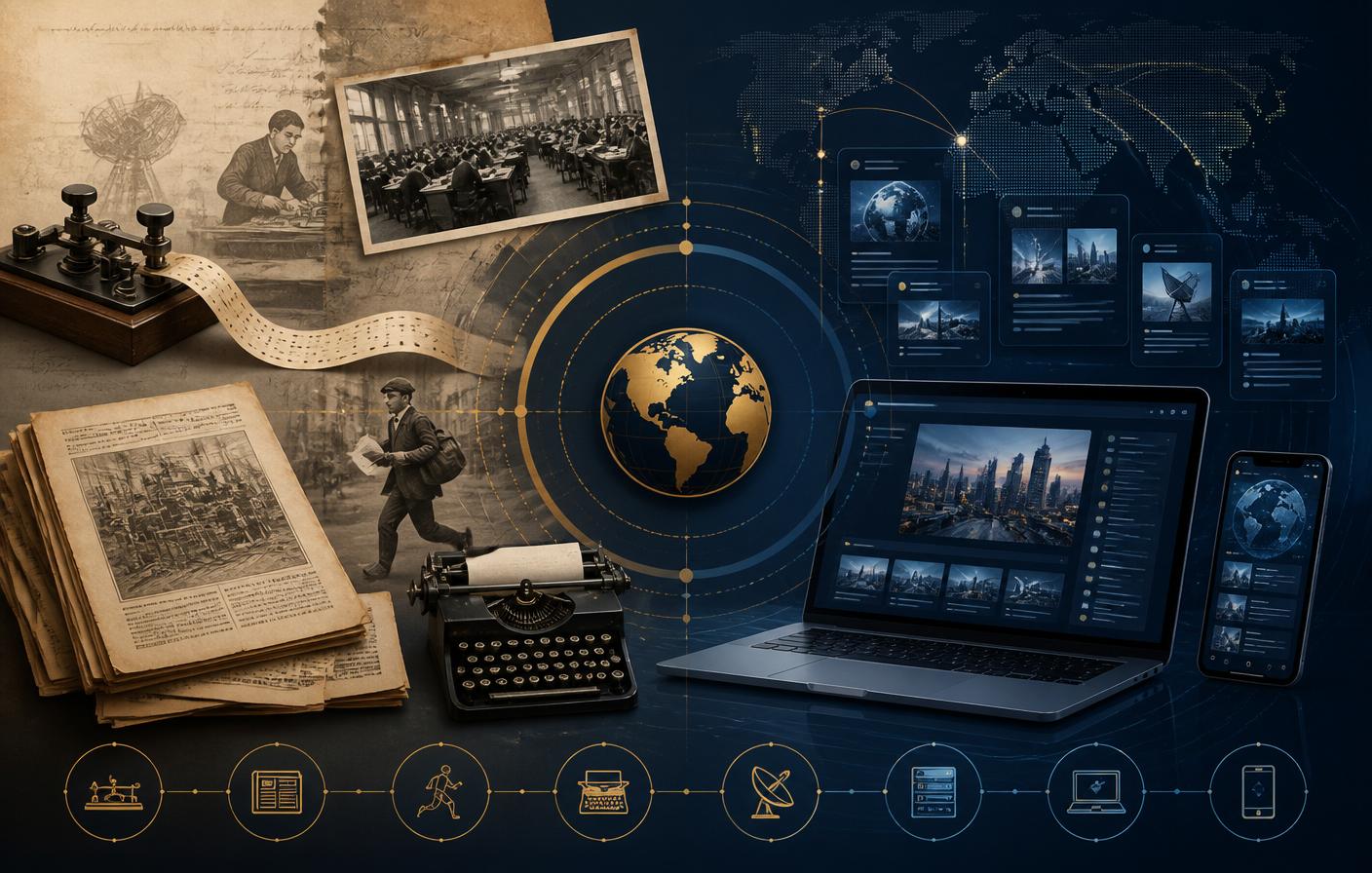
- The first modern press release was written by Ivy Lee in October 1906 after a Pennsylvania Railroad crash.
- Wire distribution as an industry emerged with PR Newswire in 1954.
- The 2000s and 2010s turned press releases from a journalist-facing document into a search-engine artifact.
Editorial disclosure: Drafted with AI assistance and fully reviewed, fact-checked, and edited by our human editorial desk before publication. Any pricing or platform detail is verified against the vendor's public pages at the time of writing.
People assume the press release is as old as the newspaper. It isn't. The format we use today — a factual, one-page, journalist-ready document — was invented barely over a century ago, by a single publicist, in response to a very specific disaster. Here's the short version of how the whole thing got here.
Before 1906: publicity by press agent
Through the 19th century, publicity work meant hiring a "press agent" — a paid mouthpiece who would pitch friendly stories, plant favorable coverage, and quietly bury unflattering news. P.T. Barnum was arguably the most famous of these. There was no format, no standard way to submit, and no expectation that a company would tell its own story in a journalist's voice. Companies avoided the press; the press worked around them.
1906: Ivy Lee and the birth of the modern release
On October 28, 1906, a Pennsylvania Railroad train derailed near Atlantic City, killing more than 50 people. The railroad's usual response would have been silence. Ivy Ledbetter Lee, a former New York Times reporter working as a publicist for the company, did the opposite: he wrote a statement of facts, invited reporters to the scene, and issued the first document historians recognize as a modern press release.
The New York Times ran it verbatim. Lee had accidentally invented an entire industry. Two years later, he published his famous "Declaration of Principles" — the founding document of modern PR — arguing that publicists owed the public accurate, timely information rather than propaganda. For more on Lee's role, the Wikipedia entry is a solid starting point, and the Museum of Public Relations maintains an archive with primary sources.
1954: PR Newswire and the wire era
The distribution problem — how to get one release to hundreds of newsrooms fast — didn't get a scalable answer until 1954, when Herbert Muschel founded PR Newswire in New York. The wire teleprinted releases directly to newsroom terminals in exchange for a fee. Business Wire followed in 1961. For the next four decades, "sending a press release" essentially meant using one of two wires.
This era standardized the format. AP style became the default. The dateline, the boilerplate, the "###" end mark — all wire conventions from this period.
2000s: the internet rewrites the release
Two things changed the game around 2000. First, wires started publishing to public websites, which meant press releases became directly readable by the public for the first time. Second, Google began indexing news content, and press releases turned into a search-engine artifact almost overnight.
The 2010s brought a wave of low-cost distribution wires — EIN Presswire, PRLog, 24-7PressRelease, and dozens more — that undercut the legacy players by an order of magnitude. The format didn't change much, but the price collapsed and the audience pivoted from "beat reporters" to "search engines and casual readers."
Today: AI, search, and the second reinvention
The press release is being reinvented again. AI drafting has become baseline — many modern wires (ours included) offer AI-assisted writing right in the submission flow. Google News indexing has become the primary success metric. And direct journalist outreach, once the whole point of a wire, is now often layered on top rather than replaced.
The format Ivy Lee invented in 1906 has proven remarkably durable. A modern release would still be recognizable to him — dateline, lead, quote, boilerplate. What's changed is who reads it, how fast it gets there, and how long it stays discoverable. If you're writing your first one, our beginner's walkthrough picks up right where Lee left off.
Frequently asked
Who wrote the first-ever press release?+
Ivy Ledbetter Lee, a former New York Times reporter turned PR pioneer, in October 1906.
What was the first press release about?+
A fatal Pennsylvania Railroad crash near Atlantic City. Lee released the facts to reporters proactively — a radical move in an era when companies stonewalled the press.
Are press releases still relevant?+
More than ever, though the audience has shifted. In 2026, roughly half of all release value comes from search-engine indexing rather than journalist pickup.
Head of Distribution · Press Release Submit
Tony has spent the last eleven years inside newswire desks and comms teams — routing releases for public issuers, Series C rounds, and more crypto launches than he wants to admit. He writes the guides he wishes he'd had when he started.
Ready to send yours? First release is on us.
Verified new accounts get one full distribution free — same network, same live-link report, no card.
Claim your free release